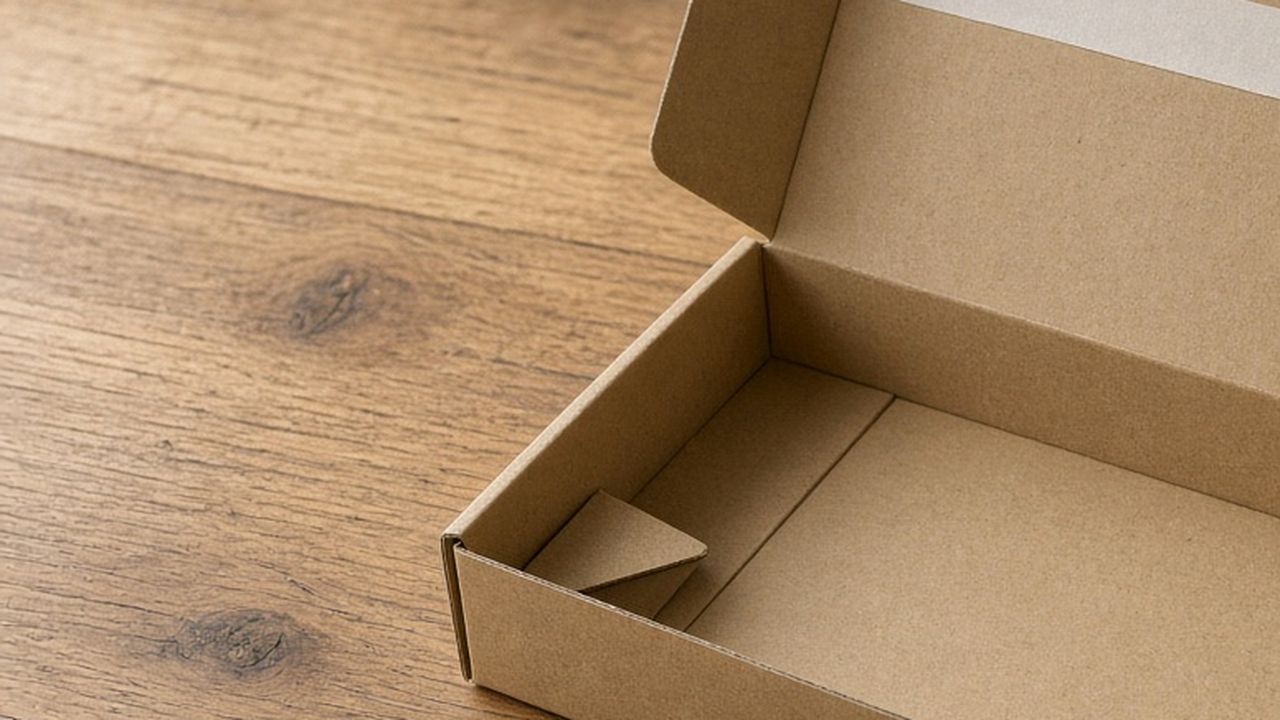
Measure the goods before you measure a carton you hope will do
A size you will buy again has to be written down in a way the next person can order without the sample in their hands. Start with the goods. Length, width and height, in millimetres, including lids, handles and anything that cannot be folded. That is the minimum cavity. A carton smaller than that on any side does not fit. A carton much larger on any side is a void-fill order you will repeat forever. How a box size is chosen is the short version. The shape before the board is why you pick a cube, a wrap or a tube before you chase a millimetre.
If you already have a carton that works, measure that too, and label the two sets of numbers. “Goods” and “carton we liked” are different notes. People reorder the goods measurement as if it were a carton code, then wonder why the next delivery is tight. Categories print a carton size. They do not print your product.
Measure to the nearest sensible millimetre and do not round “up to be safe” by several centimetres. The safe version is a bigger carton, more fill, and sometimes a dearer parcel. The safe version of a tight fit is to check the flaps close without crushing, not to jump two sizes.
Internal and external are different numbers
Board has thickness. An internal measurement is the cavity the goods see. An external measurement is the outside a carrier sees, and the outside a pallet sees. Wardrobe boxes on this site state that their sizes are internal. Royal Mail small parcel limits are external: 450 mm long, 350 mm wide and 160 mm deep, on our changes page. If you write “450 × 350 × 160” next to a product without saying inside or outside, the next order will be ambiguous.
A made-up carton with tape and a slight bulge can be larger outside than the flat blank suggested. If the parcel has to stay a small parcel, measure a finished, taped sample, not the flat board and not the goods. A roll has its own rule on that page: up to 450 mm long and 80 mm in diameter to remain a small parcel. Do not record a tube with the three-number cube format and expect the diameter to be obvious later.
Double wall is thicker than single wall. The same nominal size in a stronger board can steal a little cavity and add a little outside. Single wall and double wall is the board choice. When you change board, measure again. Do not copy the old note across and change only the word “single” to “double”.
Write the shape and the board on the same line
A note that says “300 × 200 × 150” is not yet an order. Say whether it is a single wall cube, a double wall cube, a crash lock, a book wrap, a tube, an archive box or a wardrobe box. Crash lock sizes we list are specific: 110 × 110 × 95, 160 × 150 × 85, 200 × 100 × 100, 222 × 150 × 88, 290 × 208 × 95 and 330 × 220 × 150 mm, on 150K/T board. If your note is one of those, say crash lock. If it is not, do not force it into that range because the bench likes the peel-and-seal strip.
White postal boxes are a finish. If the outer has to be white, write white, and still write the size. Archive boxes are A4 file cartons with handles. Wardrobe sizes are internal and include a rail. Mixing those words up is how a file box arrives for a dress, or a white postal carton arrives for a move. Box shapes is the index. Boxes is where the cubes live.
Keep the note where the reorder is placed, not only on a carton in the warehouse that will be thrown away. The product page quantity is the other half of the note: how many you buy when you buy. A perfect size in a pack of a thousand, when you send twenty a week and have no room, is the wrong quantity of the right carton.
Check the note against a sample before it becomes the standing order
Pack the real goods into one carton from the delivery. Close it as you will close it in production, with the tape you will use. Shake it gently. If the goods move, the size or the fill is wrong. If the flaps crush the goods, the size is wrong in the other direction. Measure the outside if it will be posted. Then, and only then, let the note become the line you reorder. A first delivery is allowed to teach you. A tenth delivery of a size you never checked is a habit.
Orders placed by 3pm leave the same day, with free UK delivery over £50 ex VAT, so a corrected size does not need a long lead time. TradePro, for trade businesses, starts at 5% and goes to 10% over £1,000 a month. Use it to reorder the size you have proved, not to buy five candidates more cheaply. Stocked items can be returned within 14 days if the unproved size was wrong. Call and arrange the return before the cartons are taped into production.
When the note is right, stop editing it on the fly. A “slightly bigger one” added during a busy week becomes the new standard without anyone measuring. If the goods change, make a new note. Do not overwrite the old one until the new sample has been packed and measured the same way.
Store the note in the same order as the category reads it, longest side first if that is how the page is written, and say millimetres. A mix of centimetres on the note and millimetres on the page is how 30 becomes 300, or the other way round, and a carton arrives that would fit the goods ten times. One unit, one shape, one board, one size. That is the whole record.